![Engagedly dark.png]](https://help.engagedly.com/hs-fs/hubfs/Engagedly%20dark.png?height=31&name=Engagedly%20dark.png)
In a talent pipeline, stages represent the structured progression steps that show how a candidate advances toward readiness for a role. They provide a clear, visual way to track development over time.
Stages provide the progression layer of the pipeline, showing where each candidate stands in their journey toward succession or role readiness.
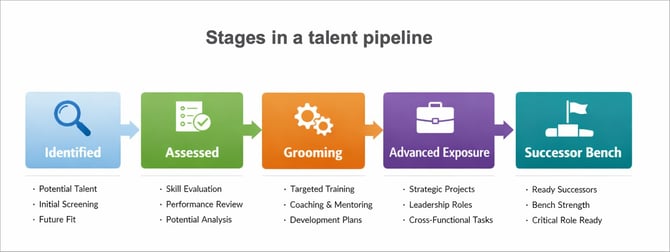
Stages in a talent pipeline
- Identified: Candidates are recognized as potential talent. At this stage, they are flagged for observation and possible development but have not yet undergone formal assessment.
- Assessed: Candidates are evaluated for skills, performance, and potential. This stage ensures that only those with the right capabilities move forward in the pipeline.
- Grooming: Candidates receive targeted development opportunities such as mentoring, training, or stretch assignments. The focus is on building competencies required for future roles.
- Advanced exposure: Candidates gain broader experience through cross‑functional projects, leadership opportunities, or strategic initiatives. This stage prepares them for higher responsibility and visibility.
- Successor bench: Candidates are marked as ready successors for critical roles. They represent the organization’s immediate bench strength and can step into roles when needed.
Why these stages matter
This structured progression ensures that talent development is intentional and measurable. Each stage builds readiness step by step, making succession planning transparent and reducing risk. By the time candidates reach the Successor Bench, leaders have confidence in their ability to take on critical responsibilities.
How stages work
- Candidates are added to the pipeline and placed in the first stage by default.
- They move across stages using drag‑and‑drop, making progression intentional and visible.
- Movement through stages does not automatically mean readiness; readiness is tracked separately to ensure evaluation is deliberate.
- The first and last stages cannot be removed, which keeps the pipeline structured and consistent.